

A football film can tell you who won in its opening minute and still hold your attention for the next 90. The result is only one part of the story. Supporters supply another: the scarf inherited from a parent, the chant learned by repetition, the player adopted as a personal hero, and the awkward search for somebody else to back once a favourite team goes home. On screen, those choices turn a match into a story about belonging rather than a sequence of goals.
A 2026 study of devoted supporters in South China describes the stands as a form of collective performance. The researchers identified bodily synchronisation, rhythmic immersion, and symbolic display as recurring parts of fan participation. That helps explain why football films linger on faces, shirts, flags, and shared movement. A crowd is not simply there to establish scale. It shows how identity becomes visible, especially when thousands of people react together, and one isolated supporter responds differently.
Where Tournament Fandom Goes Next
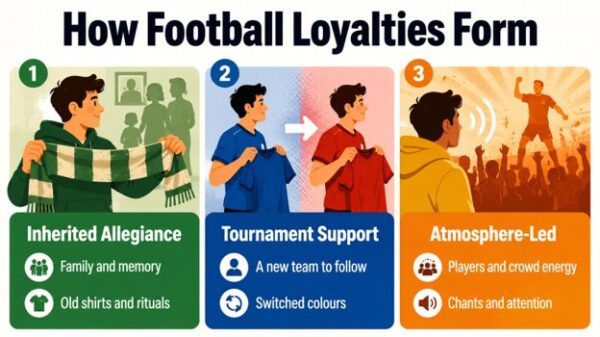
Image source: Infographic by the author
ALT text: Three forms of football allegiance
Permanent allegiance and tournament interest are easy to confuse. A supporter may keep one club or country at the centre of their identity while temporarily following another team, admiring a particular player, or attaching themselves to the loudest crowd left in the competition. Screen stories can make those layers visible within seconds.
Football imagery also travels beyond films and documentaries into shorter, more interactive forms of entertainment. The homepage at Lucky Rebel presents a broad sports and casino destination, including a football-themed collection built around recognisable ideas, such as kick-offs, goals, cups, supporters, and penalties. Those motifs work because viewers already know the emotional vocabulary behind them.
A cup signals a tournament before any story is supplied; a penalty suggests a single decisive moment; supporters imply that the event matters to somebody beyond the players. This is different from the patient character development of a film, but it draws from the same store of matchday images. The format depends on instant recognition rather than the detailed social history that a feature film can patiently build. Lucky Rebel therefore provides a useful example of how football identity can be condensed into titles and visual cues without pretending that every person attracted to them holds a lifelong allegiance. Temporary interest, familiarity, and simple curiosity can be enough.
A short set of World Cup fan interviews shows those distinctions in ordinary speech. Mexico supporters move towards Spain after elimination, family members influence the choice, dyed hair turns support into a visible performance, and one spectator remembers the Lukaku header he hoped to see. The clip is anecdotal rather than representative, but its details resemble the small character signals that films use to make a crowd legible.
Three Forms of Support on Screen
Football films about fans become clearer when support is separated into three forms. They can overlap, but each produces different behaviour and gives filmmakers different material.
| Form of support | What drives it | Useful screen signals |
| Lifelong or inherited | Family, place, memory, and repeated commitment | Old shirts, shared rituals, stories of earlier matches, and loyalty after defeat |
| Temporary tournament support | A preferred team has exited, leaving another side to follow | Switched colours, conditional language, fresh predictions, and interest tied to the remaining fixtures |
| Atmosphere-led attachment | Attraction to a player, style of play, or supporter culture | Chants copied from another crowd, fascination with one performer, and repeated comparisons between stadiums |
The first form usually carries the greatest dramatic weight because a defeat can feel connected to family history or personal identity. The second creates lighter, more flexible stories: a character can change colours without erasing the team that mattered first. The third lets a film show allegiance forming in real time. A chant, performance, or crowd can win someone over before they know much about the side itself.
These cues also affect tone. Inherited support suits stories about memory and obligation, while temporary support can introduce humour, uncertainty, or a new relationship between characters who began the tournament on opposite sides.
Changing Sides Is Not One Simple Decision
Films often treat loyalty as absolute because it creates clean conflict. Actual fandom is layered. A supporter can remain attached to a local club or national team while following another side, player, or crowd for the rest of a tournament.
Khyentse Norbu’s The Cup makes that flexible attachment central. Tibetan monks living in exile in India become absorbed in the 1998 World Cup and organise a television to watch France play Brazil in the final. Their interest is not inherited from either country or presented as permanent.
Johan Kramer’s documentary The Other Final goes further. It follows Bhutan and Montserrat, then the world’s lowest-ranked national teams, playing on the day of the 2002 World Cup final. As Bhutan pulled ahead, sections of the home crowd began cheering Montserrat, turning sympathy for the outsiders into a temporary second allegiance for one unusual afternoon.
That response fits a 2026 study that found a distinct European fan identity alongside club and national attachments. The research identified overlapping forms of belonging, rather than casual abandonment of established loyalties. Both films make that distinction visible. Changing sides can mean finding somebody worth following once the original choice disappears, while family history, local identity, and older disappointments remain intact beneath the temporary allegiance.