
Why Sports Dramas with Action Elements Are Back in Trend
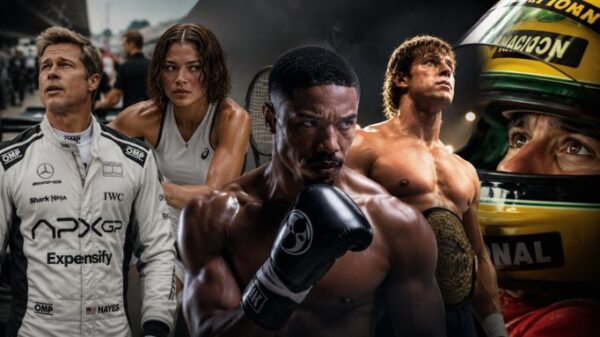
Sports drama has found its pulse again because recent films have stopped treating competition as background decoration. F1: The Movie turned racing into a $634 million global box-office event, Challengers made a 131-minute tennis triangle feel cut to match point, and Creed III opened to $58.7 million in North America with boxing scenes shaped around impact rather than nostalgia. The trend is not soft comeback cinema. It is sports storytelling built from braking zones, body shots, sweat, injury memory, and scoreboard pressure.
The car movie changed the room
Joseph Kosinski’s F1: The Movie arrived in 2025 with Brad Pitt as Sonny Hayes, Damson Idris as Joshua Pearce, and Lewis Hamilton attached as a producer. Apple said the production shot during actual Grand Prix weekends, which matters because Formula 1 fans notice wrong corner speed, fake pit walls and dead telemetry screens within seconds. The action grammar came from the cockpit: tire degradation, brake markers, dirty air, and pit strategy did more work than speeches about redemption.
Tennis learned to cut like a thriller
Luca Guadagnino’s Challengers did not need a Grand Slam final to make tennis feel dangerous. Zendaya, Mike Faist, and Josh O’Connor played a story that centered on one ATP Challenger match, while Brad Gilbert’s training helped the rallies look drilled enough to survive close camera work. Its reported $96 million worldwide gross showed there was room for a sports film where a second serve, a damaged knee and one look from the player’s box carried the weight of a plot twist.
Boxing and wrestling put pain back on screen
Creed III worked because Michael B. Jordan directed the ring scenes as emotional combat, not just franchise maintenance. Adonis Creed and Damian Anderson had history in every clinch, and the film’s opening weekend proved that a sports drama could still sell tickets when its action had personal accounting behind it. Sean Durkin’s The Iron Claw took a harsher route in 2023, using the Von Erich family’s wrestling world to raise the problem of biopolitics, which implies that athletes’ bodies are constantly being used as business assets.
Odds boards made tension measurable
The audience has changed as much as the films have. During a Grand Prix, tire wear, Safety Car timing and a two-stop strategy can move live podium prices before the next sector split appears on screen. For viewers already reading sport as data, MelBet (Arabic: ميل بيت) sits inside a wider betting conversation about live markets, odds suspension, bankroll caps, and KYC checks rather than a claim that drama can be priced cleanly. The better films understand that uncertainty is not decorative; it is the whole machine.
Streaming turned the arena into a six-hour watch
Netflix’s Senna runs for six episodes, beginning with Ayrton Senna’s Formula Ford days and building up to the 1994 San Marino Grand Prix at Imola. The racing scenes benefit from having time to breathe, with episodes stretching from 53 to 71 minutes instead of squeezing every rivalry, family moment, and paddock clash into a single film. That kind of pacing works well for sports drama, since training, travel, contract issues, and risk all need to be shown more than once; one race or fight rarely tells the whole story.
The second screen now sits beside the plot
Sports stories now reach viewers who are used to checking stats feeds, live blogs, fantasy leagues, and injury reports at the same time. Someone watching Monaco 1988 in Senna or a made-up final lap in F1 might already know about undercuts, track position, and how a single mistake can shift a race. On a second screen, MelBet (Arabic: ميلبت) fits into that same stream of information alongside line changes, pre-match odds, and cash-out options, as long as bets stay small and odds are treated as indicators of risk rather than advice. That’s part of why action-driven sports drama feels relevant: because it mirrors the pace of live sport without suggesting the result can be controlled.
The next wave cannot fake the details
The baseline for the genre now is getting the details right. Football fans will notice a sloppy press, boxing fans can tell when a punch is pulled, and Formula 1 viewers will question a pit stop that ignores tire rules. The next strong sports drama won’t stand out by repeating familiar underdog stories; it will stand out by nailing the small things, from the towel in the corner to the radio call before Turn 1.