
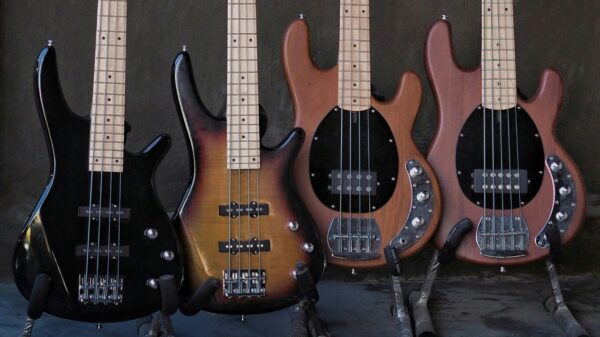
Musicians believe that guitars are the primary voice in a performance or recording. While lead tones and chord textures are in the limelight, a good representation of low-end presence completes the picture. This depth is an advantage of a balanced collection, and a Stingray bass provides exactly that: substance, tonal variety, and flexibility. The addition of one to a setup alters the interaction of instruments, providing a foundation that enhances the overall sound.
Filling Out the Range
Electric guitars are more likely to occupy mid to high frequencies. The space there is large enough to support the bass beneath. In its absence, arrangements may be thin or ungrounded.
The spectrum is filled with a Stingray bass, with clear definition and a tight low end. It has a powerful voice and control that make it appropriate in dense mixes or even stripped-down arrangements. This quality can be maintained without difficulty, as it is easy to place on a track.
Strength Through Contrast
No two guitars are the same, and the same is true of basses. The bass models also have their own voices, just like various pickups, wood types, or scale lengths alter the tone of a guitar. A narrow, targeted response and a specific push in the middle range characterise the Stingray. These features make it more distinctive than single-coil pickups, humbuckers or hollow-body guitars. Such a contrast makes it clearer, and each instrument has more space to be heard.
Reliable Across Styles
A versatile instrument collection is needed to span several genres. Some basses may find it challenging to switch between funk, indie, and heavier rock tones. The Stingray is a versatile model that is easy to adapt due to its onboard electronics and pickup.
This model is accurate whether it is used for a sharp attack to create a groove-heavy track or for warming the sound at slower tempos. Its versatility across styles makes it a dependable tool.
Impact on Composition
Bass does not just hold down root notes. It determines the rhythm of words and the distance between them. A bass guitar in the composition process usually results in more complete compositions. With a Stingray bass around, transitions, tension, and energy discharge can be more easily shaped by well-timed notes. Such decisions help establish verses and choruses, which affect how guitar sections are stacked and where vocals are placed in the mix.
Recording Benefits
Layering multiple tracks in a recording requires careful attention to tone. Guitars can compete for space if there’s no clear anchor. A bass with clear articulation solves this problem by locking in the rhythm and tying everything together.
The Stingray bass shines in this environment. Its clean response reduces the need for heavy EQ correction, allowing it to sit naturally with acoustic and electric textures. This saves time and preserves the musicality of each part.
Stage Presence
Live performances are a heavy burden on equipment. The instruments must handle volume changes, changing acoustics, and extended sets without losing their tuning or sound. Although guitarists can bring multiple instruments to a performance, a bass that can do everything makes preparation easier.
Here, the Stingray’s tone controls and build quality will come in handy. It slices through mixes across various venues, adapts quickly to variable setups, and remains consistent under pressure. The outcome is improved performance on stage with fewer technical issues.
Blending With Others
Musicians typically perform in bands, and the instruments should work together. Bass that complements percussion and melody improves unity. The Stingray model is well-suited to drums and rhythm guitars. Its low end is used for kick patterns, and the upper register supports keys or layered parts without dominating them. This makes it more complete, more responsive as a group.
Inspiring Creative Shifts
New equipment may also introduce new ideas. Substituting a lead guitar with a bass will alter a player’s attitude, leading to variations in phrasing, rhythm, and composition.
Testing a bass can prompt consideration of styles that were not previously explored. Its tonal range invites the player to explore technique and structure, and even to affect the utilisation of other instruments.
Elevating the Entire Setup
More than variety, an extensive collection offers balance. A bass is added to provide tonal and musical versatility. It does not merely hold the guitars around it; it makes them better. Its presence alters how every piece fits within the overall performance, whether in songwriting or performance. For those who assemble a system that is compatible with their style, sounds good on stage or in the recording studio, and feels like a vital instrument to play, this bass is not only a supporting voice but also an essential component of the discussion.