
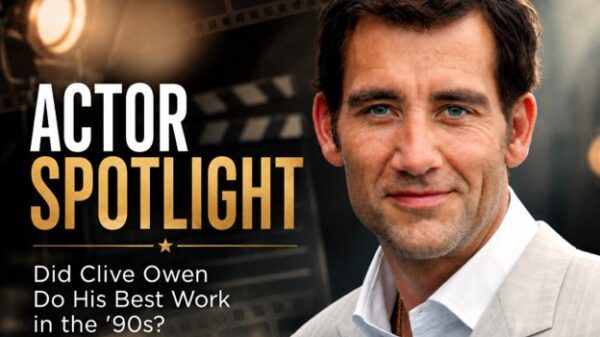
National Theatre at Home: End. This is the unreleased movie where Clive Owen stars. The actor, although having his career started decades ago, keeps being active and releasing new movies, although one question interests many of his fans: Did his best stay in the 90s?
What makes Owen so worth revisiting is that he rarely sells emotion in large gestures. He lets a role gather force. For an actor like that, a decade matters. Form, rhythm, and tone matter. The ’90s may not contain every peak in his career, but they may contain the purest version of what makes him singular.
Croupier and the elegance of control
If the case for Owen’s best work in the ’90s rests on one performance, it rests on Croupier. As Jack Manfred, he finds a role that turns restraint into style. Jack moves like a man measuring space, timing speech, and filing every detail away for later use. Owen makes that watchfulness magnetic. That is why the casino setting matters so much when we define the character.
In a weaker movie, the tables might just be there to show glamour or risk. But here, they become part of how the whole world works.
You notice:
- the wheel spinning,
- the pause before the ball stops,
- the croupier handling chips neatly,
- and the repeated phrases that almost sound like music.
Owen understands that this world has a rhythm. Jack looks comfortable inside it, not because he is carried away by the excitement, but because he understands how carefully the whole place is built.
That is also why the film still feels current in an era shaped by roulette casino games on mobile screens as well as on physical tables. The surface has changed, but the appeal has not. What Croupier captures so well is the quiet pleasure of structure. Chance is part of the experience, of course, yet so is design. Jack sees roulette less as chaos than as form. He knows that suspense comes from order: the wheel, the pattern, the brief held breath before the result.
This feels like Owen’s defining role
Owen’s performance makes all of this feel natural rather than studied. He never overexplains Jack’s connection to the table. He lets it show in posture and tone.
This is how the movie Croupier starts, putting roulette imagery at the forefront.
Screenshot from the opening scene of the movie.
Even now, when online roulette offers a cleaner, faster version of the same anticipation, the performance still lands because it gets at something basic and enduring: the attraction of repeated ritual, polished surfaces, and controlled uncertainty. That is why Croupier does not just look like an important Owen role. It looks like the role in which his screen identity locks into place.
Why the decade suited him so well
Part of the reason Croupier lands with such force is that it arrived during a period when British cinema had more energy, more reach, and more confidence in adult stories built around mood and character. The decade was not just busy. It was expanding fast, and that expansion created room for actors like Owen, whose appeal depended less on easy charm and more on precision.
Figures sketch the scale of that shift:
| Measure | Early figure | Later figure |
| Investment in UK features | £169 million in 1992 | £560 million in 1996 |
| UK films produced | 30 in 1989 | 128 in 1996 |
| UK cinema admissions | 97 million in 1990 | 139 million in 1997 |
| British share of the box office | 11% in 1990 | 23% in 1997 |
Owen has always benefited from film cultures that trust texture. He is not an actor who needs endless explanation. He needs framing, pace, and a script willing to let a character stay partly unreadable. Late-’90s British cinema, at its best, gave him exactly that. It had a taste for urban cool, adult tension, and performances that worked through suggestion.
In that sense, the decade did not simply happen to contain one of Owen’s defining roles. It provided the right artistic weather for it. The question is not only whether Owen was great in the ’90s. It is whether British cinema was especially ready for the kind of actor he was. On that point, the answer looks very close to yes.
The argument against stopping at the ’90s
Still, saying Owen did his most natural work in the ’90s does not mean all his best work happened then. His later roles make that idea harder to prove.
For example, in Closer, he made his direct and harsh style feel painful, not just tough. That role earned him an Academy Award nomination and a BAFTA win. Later, his TV work also earned him a Primetime Emmy nomination.
Awards do not always prove which performance is best. But they do show that Owen kept doing strong work even after the ’90s, the decade that first shaped his image.
The later performances complicate the case
The stronger argument is aesthetic. In later work, Owen became less sealed off. He kept the control, but he let damage show through it. That is why his long-form television work matters so much when judging the full arc of his career. Writing about his performance in The Knick, Emily Nussbaum said, “Owen owns this role.” It is a short line, but an exact one. What it catches is how complete he can feel when a part asks for authority, unease, and private collapse at once.
So did Clive Owen do his best work in the ’90s? He did some of his most essential work there, and Croupier may still be the clearest statement of what makes him special. But the fuller answer is that the ’90s gave him his definitive shape, while the years after proved that the shape could hold far more than one era.